
Informations du cours
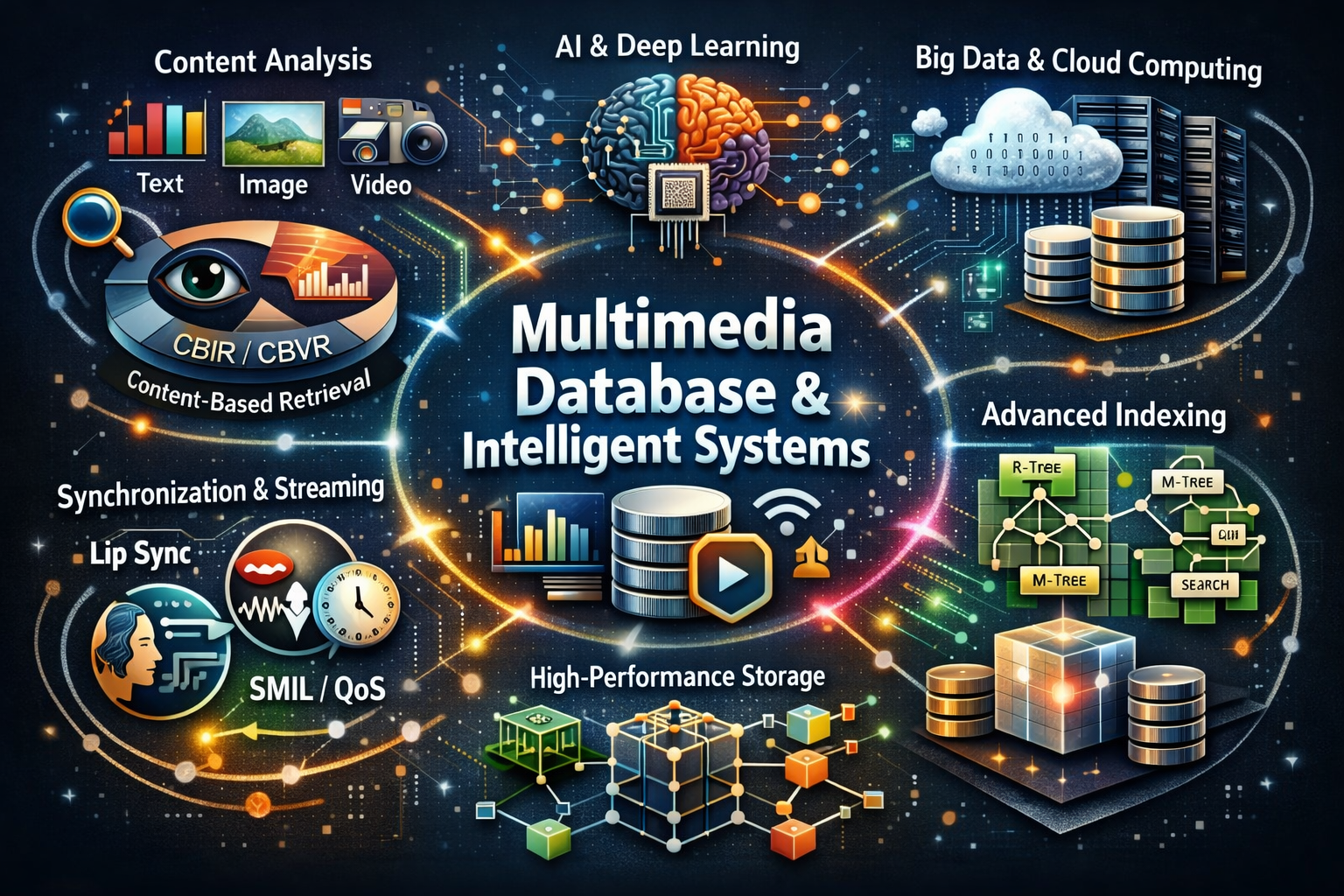
This course addresses the design and implementation of multimedia database systems, focusing on the management of heterogeneous data such as text, images, audio, and video in modern information infrastructures. It covers advanced models for multimedia data representation, full-text indexing, content-based image and video retrieval, and the extraction of low-level and spatio-temporal features, while emphasizing the limitations of purely numerical descriptions through the notion of the semantic gap. The course integrates cognitive and perceptual principles to account for human visual and auditory interpretation in similarity assessment and relevance ranking. From a systems perspective, it examines multimedia synchronization mechanisms, streaming protocols, real-time scheduling, caching strategies, and high-performance storage architectures. Particular attention is given to performance and scalability issues, including the curse of dimensionality and the use of multidimensional and metric indexing structures such as R-Trees and M-Trees. Overall, the course provides a comprehensive and future-oriented framework that bridges database engineering, multimedia processing, and artificial intelligence, enabling the development of efficient, scalable, and user-centered multimedia information systems.
- Enseignant: Sofiane BENABBES